"It's likely that not many books in the world have been acclaimed like the corpus of Khayyaam's poems, have been rejected and despised, have been altered, have met with false accusations, have been judged and condemned, have been combed through and have found general and world-wide fame, but, in the end, have remained unknown." *
*Sadeq Hedayat, Taraneha-ye Khayyaam/Songs of Khayyaam, Tehran, 1934, the opening sentence of the preface (مقدمه). The Persian is given at the end of this page.
&
How sweet is mortal Sovranty!"—think some:
Others—"How blest the Paradise to come!"
Ah, take the Cash in hand and waive the Rest;
Oh, the brave Music of a distant Drum!
Edward FitzGerald, Rubáiyát of Omar Khayyám, Stanza XII, 1st ed. (1859)
Ah, fill the cup:—what boots it to repeat
How Time is slipping underneath our Feet:
Unborn TO-MORROW, and dead YESTERDAY,
Why fret about them if TO-DAY be sweet!
FitzGerald, Rubáiyát of Omar Khayyám, Stanza XXXVII, 1st ed. (1859)
&
Sunt bona, sunt quaedam mediocria, sunt mala plura
quae legis hic: aliter non fit, Avite, liber
Martial, Epigrams 1.16
What's good, what's middling—much not worth a look;
without this mix, my friend, we wouldn't have a book.
I began this site in 2005 and have worked on it with long breaks, the longest from 2009 . I am a non-specialist, an amateur, in Persian. My hopes are that many will use this site as another resource for learning Persian, as I did early on when I started reading Khayyaam. I will continue to update ExploringKhayyaam. A site revision during 2016 and early 2017 has now been completed. I write now in 2023 with some further changes made since 2017. Other changes will doubtless follow.
I welcome your comments and questions and will respond as quickly as I can to all appropriate requests. ٰVisitors will find a "Comments box" at the bottom of each quatrain entry.
It seemed important to romanize the Persian and to do so as simply as possible for site visitors. I thought it less confusing for the viewer if I avoided diacriticals or characters, and right up front visitors will note the spelling "Khayyaam" for خیام (final syllable is a"long" a> â and this â will be written aa). Note also that the Persian consonant ع (eyn) is represented by ‘ as in ‘omr, "life-time", "age", Persian, عُمر .
I have tried to be consistent; however, as the poet Martial said, and might have said about weblogs and websites (and their contents), unevenness is in the mix.
The JOURNAL'S 39 quatrains of Khayyaam are taken from the texts of Dashti, Hedayat, and Forughi-Ghani (Mohammad Ali Forughi and Qaasem Ghani who collaborated to publish Robaa‘iyaat-e Khayyaam in 1930). These 20th century polymaths and men of letters had judged certain quatrains of Khayyaam as likely candidates for authenticity. Concurrence of very nearly all three texts in each of the relevant postings is my reason for selecting them.
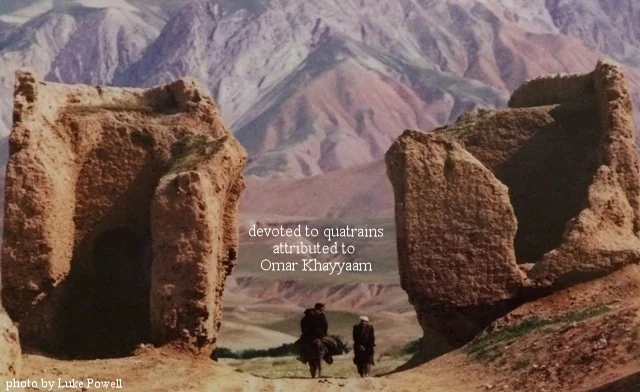
Luke Powell's banner photograph, "City Gates" (Tashkurgahan, Afghanistan, 1975), has been sized to fit the page. It is from my own collection. The photograph accompanying the JOURNAL is also by Luke Powell, "Autumn Village" (1986 -- the village is just north of Shiraz, according to Powell). The photo is in my own collection as well and is sized to suit the page.
Sizing the photograph causes a lot to be lost and does not reveal the beauty of Luke Powell's photographs.
And "lost in translation".... Robert Frost did say that a translation should "talk a poem into English?" I thought that was the quote; however, what Frost likely said was this: seeing Stanley Burnshaw's edition of The Poem Itself, Frost remarked, "Instead of translating a foreign poem, you discuss it into English." This remarkable book does not offer translations of the French, German, Italian, Spanish and Portuguese poems contained within, rather, in the notes following the text, there is a line-for-line translation which accompanies discussion of the poem.
Frost had said about poetry that it was what "got lost in translation." I am assuming without seeing this celebrated quote in context that he was talking about what gets lost in paraphrase of "English to English" or "translation" from a foreign language into English. Leaving aside for now this assumption, I would like to quote an admonition for those who translate verse from another language into English:
The assertion that it is the translator's duty first and foremost to write a poem needs to be accompanied by a reminder that every poem (that is a poem) is a new poem. Every poem is an experiment. An urgent original, one that, in Osip Mandelstam's phrase, disturbs meanings, must not be turned into something the opposite of urgent, something faded, that does not press to be uttered. Which is what most often happens. Poems that once were disturbers of meanings are turned into faded imitations of themselves, where all meanings lie deathly quiet. Any technique that prevents the Englishing of a poem in this way is unfit for use. Any that distracts from the translator's prime duty is to be eschewed (Peter Whigham, "Introduction," p. 39, Epigrams of Martial: Englished by Divers Hands, J.P. Sullivan and Peter Whigham, eds., University of California Press, 1987).
In his "new poem," Edward FitzGerald's genius lies in giving voice to what in Khayyaam "presses to be uttered."
------------------------------------
*Hedayat’s opening sentence at the top of this page:
شاید کمتر کتابی در دنیا مانند مجموعهٔ ترانههای خیام تحسین شده، مردود و منفور بوده، تحریف شده، بهتان خورده، محکوم گردیده، حلاجی شده، شهرت عمومی و دنیاگیر پیدا کرده و بالاخره ناشناس ماند